Small Bathroom Storage: Over-the-Toilet and Rental-Safe Ideas
This post may contain affiliate links. If you buy through them, we may earn a small commission at no extra cost to you.
A small rental bathroom usually offers you exactly four storage surfaces: a sliver of counter, the inside of a mirrored cabinet the size of a lunchbox, the floor (no), and — if you're lucky — one towel rail in the wrong place. Meanwhile the wall space above the toilet, the tallest and emptiest zone in the room, holds nothing but air and possibly a sad framed print.
This guide builds the storage upward, the way small bathrooms have to: over the toilet first, then the door, then the walls — with every method rental-safe and drill-free. It's the deep-dive companion to our no-drill decor hacks for kitchen and bathroom; that post covers the methods (tension, adhesive, suction), this one spends them on an actual storage plan.
The order matters. Work down this list and stop when your stuff fits — most small bathrooms are solved by idea 1 plus idea 4.
1. The over-toilet ladder shelf (the hero)
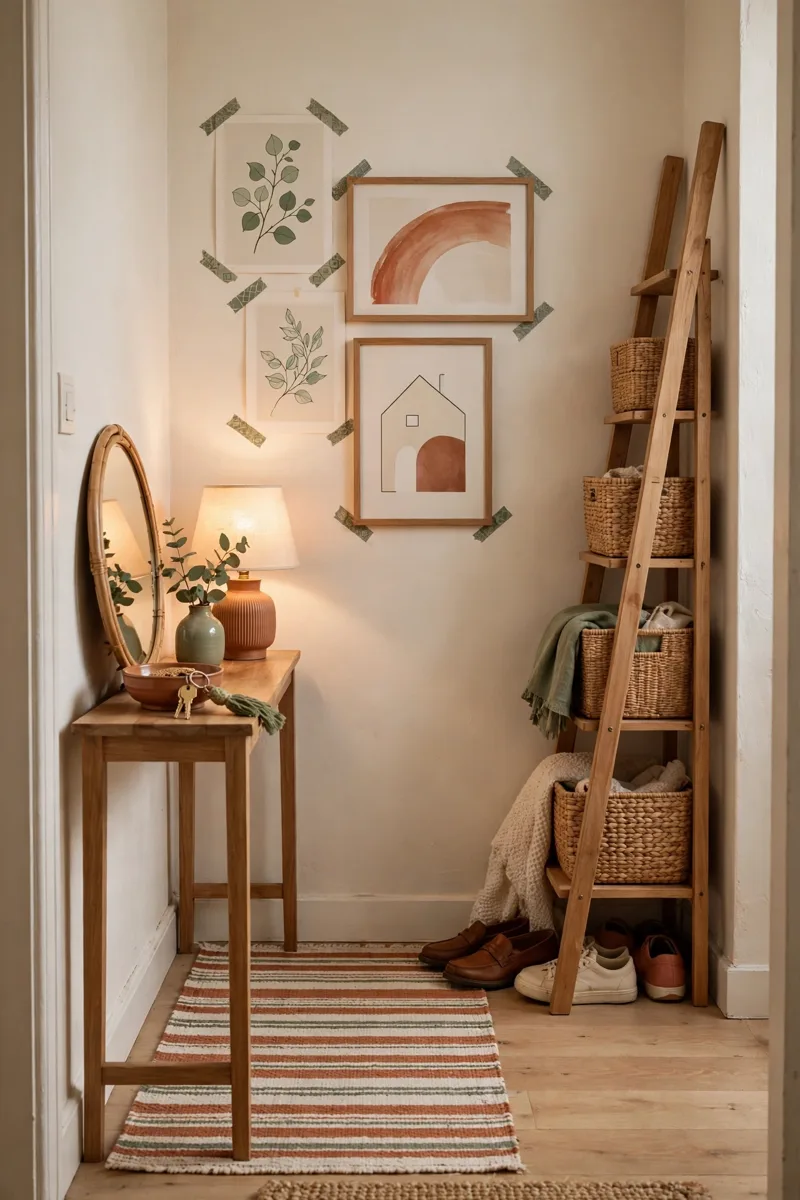
A leaning ladder shelf or an over-toilet etagere standing behind the tank: two or three shelves holding rolled towels, a trailing plant, and the pretty bottles. The leaning style uses floor contact only — nothing touches the wall, nothing to remove at move-out but the shelf itself. Measure your tank depth and the flush clearance first; most units need about 8 inches behind the bowl and the shelf's lowest rung above the tank lid. Typical cost: $35–70, and it moves with you forever.
2. The tension pole with shelves (the tallest option)
Floor-to-ceiling tension pole, two or three clip-on shelves, placed in the corner beside the toilet or at the end of the tub. It stores more than the ladder and reads more "built-in spa." In steam terms it's the safest system in this post: no adhesive anywhere near the shower's humidity, and it comes down in ninety seconds.
3. Two open shelves' worth of storage — without the shelves
No drilling means no floating shelves, so fake their effect: a long woven basket on top of the tank (extra rolls, a small plant), plus a wall-mounted look achieved with steam-rated adhesive rails on glazed tile only. If your bathroom is painted drywall — most are — skip adhesive rails entirely and lean on ideas 1, 2 and 5. A system you trust beats a prettier one you're waiting to fall.
4. The one-basket counter rule
Everything that lives on the counter fits in one basket or tray: daily products only. Everything else — refills, duplicates, the seven almost-empty bottles — goes in a lidded box under the sink or in the rarely zone. Counters in tiny bathrooms don't need organizers; they need a border. The basket is the border. This is the same zoning logic as our small entryway storage system: one defined container per surface, chaos physically cannot spread past it.
5. The door: towel ladder and pocket organizer
An over-door towel ladder takes the towels the single rail can't; a slim over-door pocket organizer on the inside takes hair tools, brushes and cleaning supplies. Together they add the storage of a small cabinet for about $25, using a "wall" your landlord has no rules about. Choose padded or silicone-coated hooks to protect the door's paint — and check the door still closes fully with the rack loaded before you commit.
6. Under-sink: stack, don't pile
The cabinet under the sink is dark, pipe-cut and usually a single cavern. Two stackable bins or a small two-tier organizer turn it into floors: cleaning supplies below, refills and rarely-used items above. Add a tension rod under the sink to hang spray bottles by their triggers — a $3 trick that frees the entire cabinet floor.
What goes where: the quick map
Daily (counter basket + top shelf): toothbrush kit, face products, one towel each. Weekly (middle shelf + door pockets): hair tools, laundry-day supplies, spare towels. Rarely (under sink, top tier): refills, first aid, guest extras. If a daily item is stored in a rarely place, you'll stop using the system by Thursday — the map is the maintenance.
The guest test and the cleaning test
Two checks keep a small bathroom system honest. The guest test: a guest should be able to find a hand towel, spare toilet paper and soap without opening anything or asking. If any of the three requires a cupboard dive, move it to the over-toilet shelf or the door — guests are the usability testers your bathroom will actually get. The cleaning test: every storage piece must let you wipe the surfaces under and behind it in under two minutes. Ladder shelves lift or slide; tension poles stay put but their shelves unclip; the counter basket moves as one object. If a system makes cleaning harder, it will slowly make the bathroom dirtier, and no amount of pretty storage compensates. Run both tests the week you set up, not the month you move out.
One more honest note on cost: the full six-idea version of this room runs about $90–140 if you buy everything new. You almost certainly don't need everything. The ladder shelf plus the counter rule (ideas 1 and 4) solve the large majority of small bathrooms for $35–70; add the door rack when towels overflow, the tension pole when products do. Buy in that order, and stop the moment the room works.
Small bathroom, big household
Everything above assumes one or two people. Add kids or a third adult and the map changes in two places. First, the counter basket becomes one basket per person — small, lidded, and carried to the bedroom if counter space truly can't hold three; shared counters survive on rotation, not on square inches. Second, towels multiply past what any shelf displays well: keep display towels at two per person maximum on the over-toilet shelf and move the household's working stock to a lidded hallway or bedroom-closet box, swapped on laundry day. The zones (daily/weekly/rarely) don't change — only the rarely zone gets bigger and moves out of the bathroom entirely. That's the general rule this whole system runs on: when a small room overflows, the answer is a zone elsewhere in the home, not more organizers in the room.
FAQ
Is over-the-toilet storage safe in a rental? Freestanding and tension systems touch no walls and are the safest storage you can add. Just confirm measurements (tank depth, ceiling height for poles) and keep heavy items on the lowest shelf for stability.
How do I store towels in a bathroom with no linen closet? Rolled, on the over-toilet shelf's top level — visible, dry and off the counter. Keep two in rotation per person and store the spares in the bedroom closet's rarely zone instead.
What if my bathroom has zero floor space for a shelf unit? Go door + tension: an over-door ladder and a slim under-sink stack cover most needs. Wall-dependent ideas can wait for a bigger bathroom; these two move with you.
How do I keep open bathroom shelves from looking cluttered? Decant into matching bottles, group by height, and let one plant do the decorating. Open shelves show everything, so the rule is fewer, prettier, corralled — baskets hide the rest.
Build it in an afternoon
Measure the toilet zone, order the ladder or the pole, and set the one-basket rule tonight — those three moves cover 90% of small bathrooms. For the method details (which adhesives survive steam, how suction really works), read the no-drill kitchen and bathroom hacks next, and let the free checklist keep the rest of the apartment's storage just as honest.
Get the Free Renter-Friendly Makeover Checklist
Room-by-room no-drill steps, a budget tracker and a move-out undo log — free PDF, no email needed.
Download the Free Checklist