Studio Apartment Divider Ideas: One Room, Three Zones
This post may contain affiliate links. If you buy through them, we may earn a small commission at no extra cost to you.
The hardest thing about a studio isn't the size — it's that one room has to be three rooms wearing a trench coat. You sleep where you work, you work where you watch movies, and your brain never fully clocks out of any of it. The fix isn't more space. It's borders. Real rooms are just zones with strong enough signals, and a studio can fake every one of those signals without building a single wall.
Below: the three zones every studio needs (sleep, live, work), the dividers that actually separate them, and the rules that keep light and air moving in a room that can't afford to lose either. This guide zooms into the studio plan from our 500 sq ft apartment layouts post — if your whole home is under 500 sq ft, read that one for the full floor plan and this one for the dividers themselves.
The two laws of studio zoning: 1. Dividers under 40 inches keep light; taller ones need gaps. In a one-window room, a solid tall divider doesn't make two rooms — it makes one room and one cave. 2. Every zone gets its own light and its own floor. A lamp and a rug per zone. These two signals do more zoning than any furniture wall.
Divider 1 — The low bookcase (the workhorse)
A bookcase under 40 inches tall, back facing the bed, shelves facing the living zone (or open-backed, serving both). It stores for two zones at once, blocks the sightline from door to pillow — the single most valuable sightline in a studio — and never touches a wall or ceiling. Style the top with a plant and a lamp; a divider that looks like furniture stops reading as a divider at all.
Divider 2 — The curtain on a tension wire or rod
A ceiling-height curtain on a tension wire, a spring rod between walls, or a freestanding garment rack when there's nothing to tension against. Curtains are the only divider that can fully close: bed hidden, work hidden, guests over without your unmade bed attending the party. Choose a fabric with body (linen-look, not sheer) in the room's calmest color, and hang it where the sleep zone starts. Renters: tension and freestanding only — no ceiling hooks, no exceptions needed.
Divider 3 — The rug border (the invisible divider)
Two rugs, two zones, no furniture between them at all. The living rug and the sleep rug in different textures — flat-weave for living, plush for sleep — tell your feet which room you're in before your eyes check. This sounds like nothing and works embarrassingly well, especially combined with one low piece (Divider 1) at the seam. In our small bedroom ideas guide the same texture trick separates a sleep corner inside a shared bedroom.
Divider 4 — The light split
One warm lamp per zone, on separate switches, never the ceiling light for all. At night, sleep zone dark + living zone lit = a wall made of light. Working late? Desk lamp only; the bed stays in darkness and so does your sleep schedule. Light is the cheapest divider on this list and the one your body believes most.
Divider 5 — The tall plant / open shelf (the soft wall)
An open-backed tall shelf or a row of tall plants at the zone seam breaks sightlines while air and light pass through the gaps. Best at the work zone's edge (you'll want the visual calm when the desk faces it) and worst as the only bed divider — guests can see through it, and so can your 7 am alarm brain.
The sleep zone rules (the zone that matters most)
Face the bed away from the door and the work zone — waking up to your desk is a small daily tax nobody notices until it stops. Keep sleep textures soft and the palette the room's quietest; let the living zone take the bold colors. Screens live in the living zone; the bed gets a book and a lamp. And if there's a window choice, the bed takes the darker end: in studios, light is a living-zone resource and darkness is a sleep-zone one.
A sample studio, zoned start to finish
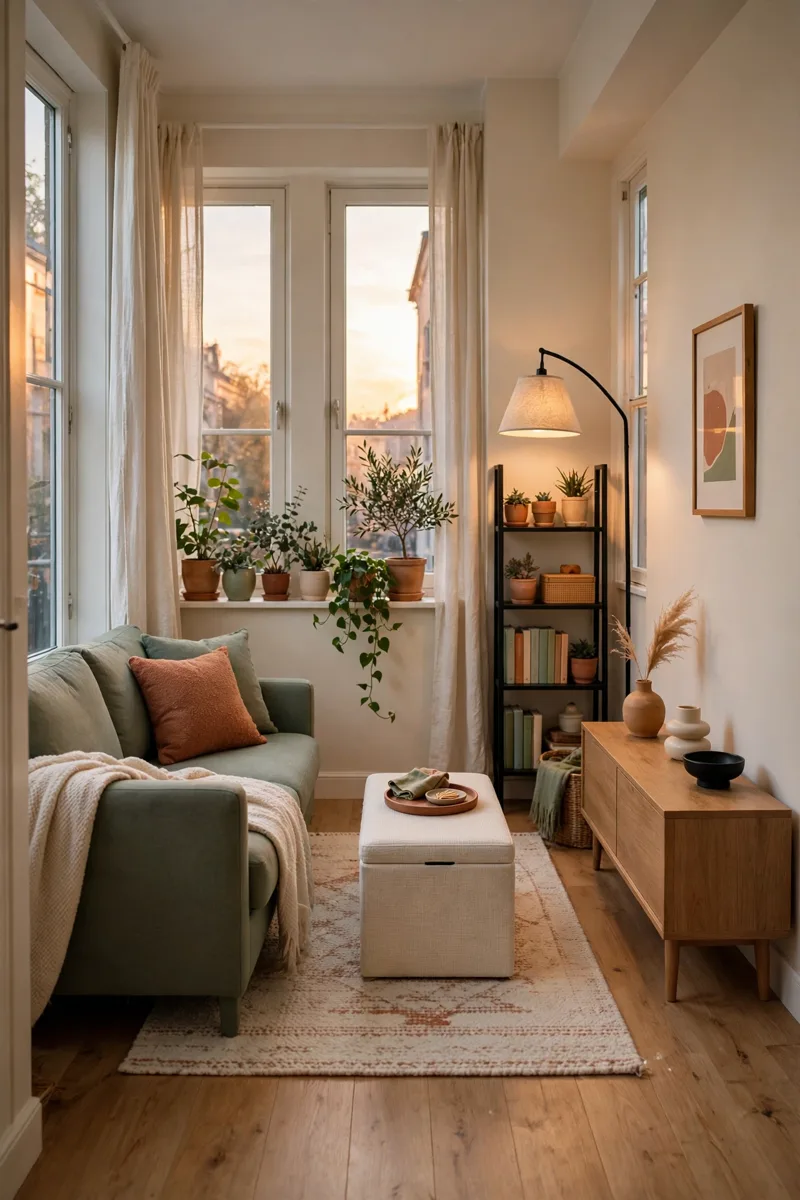
Picture a real 380 sq ft studio: door on the south wall, kitchenette along the east, one big window north, bathroom by the door. Here's the zoning we'd install. Sleep zone, northwest corner (darkest, farthest from the door): bed against the west wall, headboard north, plush rug underfoot, lamp on a small stool — no screen in sight from the pillow. The seam: a 38-inch open bookcase at the bed's foot, books and baskets facing the room, its top holding the plant and the living zone's lamp. Live zone, northeast under the window: loveseat facing the bookcase wall, flat-weave rug, TV on a low console against the east wall — daylight for living, not for sleeping. Work zone, southeast by the kitchenette: a 40-inch desk facing the south wall for calls, desk lamp only after dark, so the bed 12 feet away sits in darkness. Total divider spend: one bookcase, two rugs, three lamps — and the studio now has a bedroom, a living room and an office that each know their place.
What zoning won't fix (honesty section)
Dividers don't add storage, silence or square footage. If the studio is loud, zoning won't help — soft textiles and a rug in the live zone will, a little. If you have no closed storage, a curtain hides the bed but not the piles; in storage-starved studios the bookcase divider earns double because it is storage, and a storage ottoman as coffee table is the second purchase. And if two people share the studio, zones need a schedule as well as a layout: who gets the light zone after 10 pm is a conversation, not a furniture choice. Zoning solves the one-room-three-jobs problem. Name the actual problem before buying the divider for it.
FAQ
What is the best room divider for a studio apartment? For most renters: a low bookcase (under 40 inches) at the bed's seam — storage, sightline blocking and light preserved in one piece. Add a curtain if you host often and want the bed fully hidden.
How do I divide a studio without blocking light? Keep solid dividers low, put tall dividers perpendicular to the window wall (never across the window), and use open-backed shelves or curtains you can draw back in the day.
Where should the bed go in a studio apartment? The darkest, quietest corner, as far from the door and desk as the room allows, facing away from the work zone. If there's a nook or alcove, the bed claims it — always.
How many zones can a small studio really hold? Three comfortably: sleep, live, work/dine combined. A fourth zone (a reading corner, a dressing spot) works if it's a corner of an existing zone rather than a quarter of the room — our reading nook guide is built on exactly that principle.
Zone it this weekend
Start with the free signals — rugs and lamps in place, bed turned away from the desk — and live in the "new rooms" for a week before buying a divider. Most studios turn out to need just the bookcase after that. For the whole-apartment view, the 500 sq ft layout plans show where studios meet kitchens, and the free checklist will help you plan the zones room by room.
Get the Free Renter-Friendly Makeover Checklist
Room-by-room no-drill steps, a budget tracker and a move-out undo log — free PDF, no email needed.
Download the Free Checklist