Peel-and-Stick Wallpaper in a Rental: One Accent Wall, Deposit Safe
This post may contain affiliate links. If you buy through them, we may earn a small commission at no extra cost to you.
Of everything on the renter-friendly list, peel-and-stick wallpaper is the one people are most scared of — and the one that changes a room the most. The fear is reasonable: "removable" is a marketing word, and it's your deposit on the line.
So let's do this honestly. Peel-and-stick wallpaper, on the right wall, applied the right way, comes off cleanly — this is a mature product category now, not a hack. On the wrong wall (fresh paint, damaged paint, heavy texture), it can pull paint. This guide tells you which camp your wall is in, how to hang one accent wall in an afternoon, what it actually costs, and how removal works when you leave. It's Idea 2 in our full renter-friendly decor guide — here it gets the whole post it deserves.
1. First: should YOUR wall get wallpaper? (the 3 checks)
Check 1 — Paint finish and age. Best candidates: smooth walls with satin/eggshell or semi-gloss paint, cured at least 4 weeks (ideally much older). Risky: flat/matte paint, fresh paint, peeling or patched spots — adhesive bonds too well or pulls weak paint. Check 2 — Texture. Light texture is usually fine. Heavy orange-peel or popcorn texture shows through and weakens adhesion — the paper will bubble and lift. Check 3 — The patch test (non-negotiable). Stick a 4-inch piece in a hidden area — inside a closet, behind the sofa — for 24–48 hours. Peel it slowly. Clean release, no paint on the adhesive? You're cleared. This ten-cent test is the difference between a great idea and a deposit deduction.
And the rule above all rules from our renter-friendly guide: if your lease explicitly bans adhesive products, this one isn't for you — use the leaning/layering ideas instead and keep your record clean.
2. Where one wall does the most work
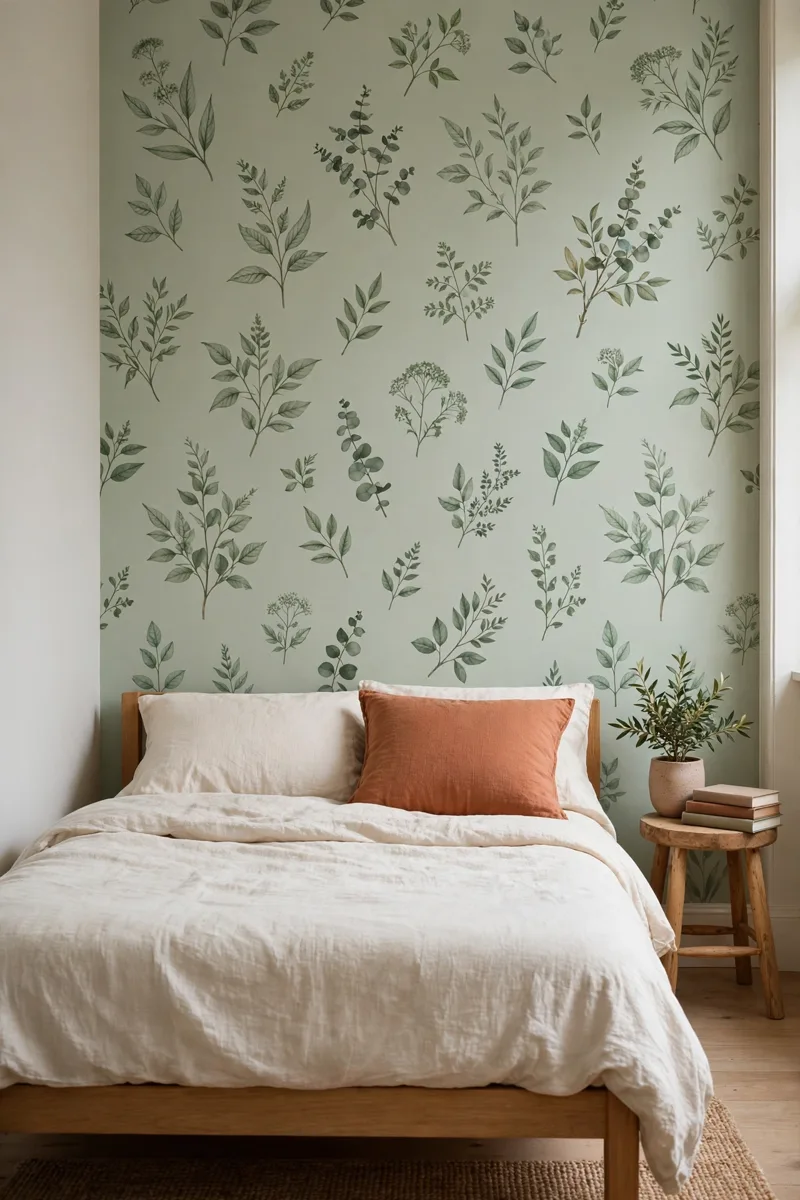
One accent wall, not a room. The wall behind your bed (the small bedroom guide calls this "the one accent" for a reason), the wall behind the sofa, or a small entryway wall. In a small room, one patterned wall adds depth — the pattern reads as distance — while four patterned walls shrink the space. Botanical and small-scale prints in soft colors (sage is the current renter favorite) are the most forgiving: pattern misalignment hides in leaves, not in geometric lines.
3. What it actually costs
For a typical accent wall (about 8×10 ft): 2–3 rolls of peel-and-stick paper. Decent quality runs $30–$60 a roll, so $60–$150 total — comparable to two large art prints, for ten times the visual change. Plus: a smoothing tool or old credit card, a sharp utility knife, a level and a step stool. Order one extra roll if your pattern has a big repeat; running short mid-wall is the classic disaster.
4. Hanging it: the two-person, one-afternoon method
- Clean the wall with a damp cloth and let it dry completely. Dust is adhesion's enemy.
- Mark a plumb line a roll's width from the corner — walls and corners are never straight; your line must be, or every strip after it drifts.
- Start at the top, peel back only the first 10–12 inches of backing, align to your line, and smooth downward with the tool, peeling more backing as you go. Small sections, no stretching (stretched paper shrinks back overnight and opens seams).
- Butt the next strip edge-to-edge (don't overlap unless the brand says to), matching the pattern at eye level first — that's where your eye checks it.
- Trim top, bottom and outlets last, with a fresh blade, in one confident pass.
- Bubbles? Lift the strip back to the bubble and re-smooth. Pricking tiny bubbles with a pin works for the stubborn ones.
Alone is possible; two people (one aligns, one smooths) is half the time and a quarter of the swearing.
Choosing a pattern that won't fight your room
Pattern choice decides whether the wall looks expensive or exhausting, and small rooms have one extra rule: the smaller the room, the more the pattern's background color matters, because that's the color the room will feel like. A sage-background botanical (like the one in this post's photos) makes a bedroom feel soft and garden-adjacent; a cream-background print with thin stems feels airier and safer still; a dark-background print is dramatic in an entryway but can swallow a tiny bedroom whole. Scale matters too — motifs between roughly 4 and 10 inches read calm at the distance a small room gives you (usually under 8 feet). Tiny dense prints buzz at close range; huge motifs need to be cropped by the wall, which small walls do awkwardly. When in doubt between two samples, tape both up and live with them for two days of changing light. The wall will tell you which one it wants.
5. Style it quiet
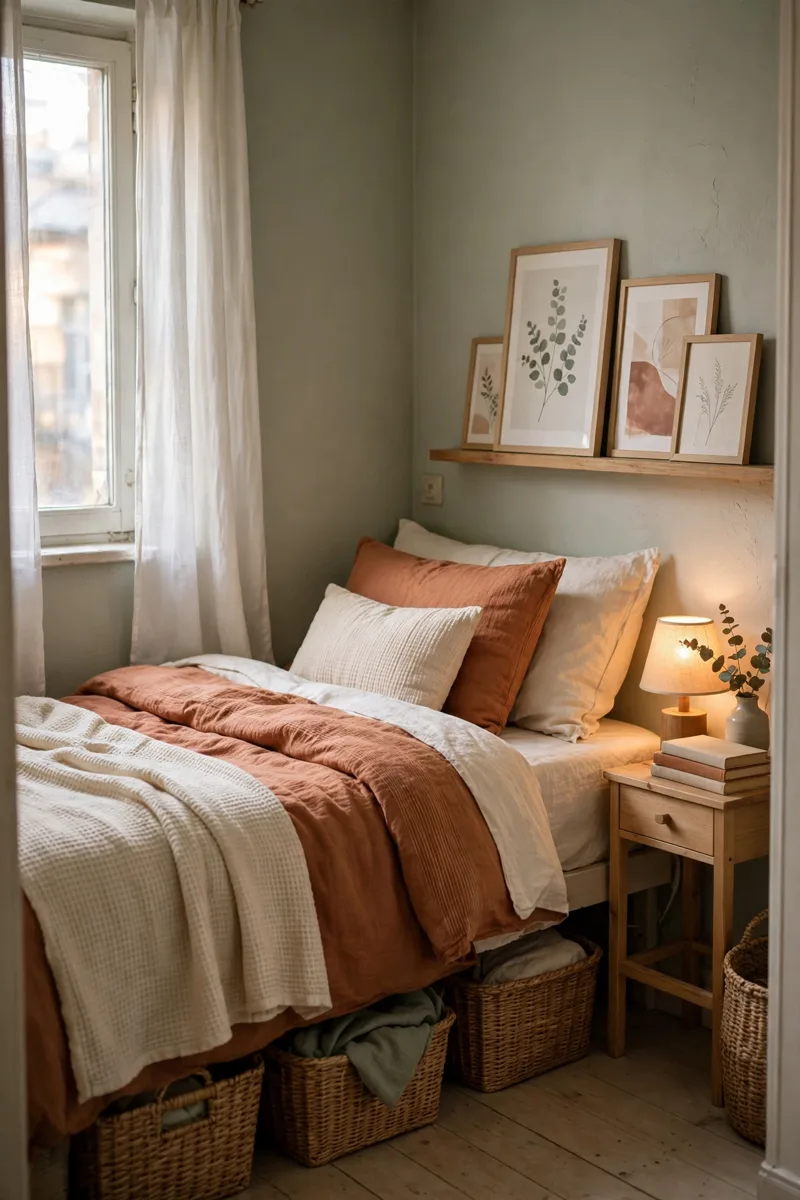
The wallpaper is the loudest thing in the room now — let it be. Keep bedding/furniture in the wall's quieter colors (cream + one accent from the pattern), art minimal or none on that wall, and let other walls stay plain. This restraint is what makes it look like design instead of a craft project.
6. Removal day (so you can relax about it now)
When you leave — or when you want a change: warm the paper with a hair dryer on medium for 20–30 seconds per section, peel slowly at a low angle, steady and unhurried. Quality paper on a qualifying wall comes off in full strips. Any faint residue wipes away with a damp cloth. Photograph the clean wall for your move-out file, next to the move-in photos from your checklist. Total time for one wall: under an hour.
Mistakes that actually cost deposits
- Skipping the patch test because the reviews said it was fine (their paint isn't your paint)
- Wallpapering fresh paint — under 4 weeks cured is the #1 paint-pull scenario
- Stretching the paper to make edges meet — it retracts, seams gap, and people then glue edges (never glue)
- Covering damaged/flaking paint and expecting the paper to hide it — it will take the flakes with it
- Cheap no-name paper with aggressive adhesive — this category rewards buying the known removable brands
FAQ
Does peel-and-stick wallpaper really come off clean? On smooth, well-cured, satin-or-glossier paint — yes, that's the product's core promise and it generally holds. The patch test tells you about YOUR wall specifically.
How long does peel-and-stick wallpaper last? Years, in normal rooms. Bathrooms with heavy steam are the weak spot — ventilation matters, and some brands rate specific lines for humidity.
Can I wallpaper just part of a wall? Yes — a panel behind the bed (framed by the bed's width, floor to ceiling) is a great budget move, and half-walls behind a console work too. Fewer rolls, same effect.
What if my landlord finds out? Read your lease first — if adhesive decor isn't banned, there's nothing to "find out"; it's a reversible furnishing choice. If it is banned, don't. No wall is worth a lease fight.
One wall is enough
Pick the wall your eyes land on when you enter the room. Patch-test this week, hang it on a Saturday, and wake up Sunday in what feels like a different apartment — one you can still hand back, spotless, whenever you choose. The free Renter-Friendly Makeover Checklist keeps your before-photos and product notes in one place, and our full renter-friendly guide has the other 14 no-drill changes waiting.
Get the Free Renter-Friendly Makeover Checklist
Room-by-room no-drill steps, a budget tracker and a move-out undo log — free PDF, no email needed.
Download the Free Checklist